
Table of Contents
- What Boho Style Means for Women Over 50
- How to Wear Boho Style Over 50: Fit and Proportion Rules
- Boho Wardrobe Essentials: Natural Fabrics and Layering Pieces
- Boho Dresses for Women Over 50: Maxi, Wrap and Midi Cuts
- Boho Outfits for Women Over 50: Formulas for Every Occasion
- Boho Accessories for Women Over 50: Shoes, Bags and Jewelry
- Building a Boho Capsule Wardrobe and Caring for It
- Frequently Asked Questions
Last Updated: October 17, 2026
What Boho Style Means for Women Over 50
Boho style is a free-spirited approach to dressing built on flowing silhouettes, natural fabrics, layered textures, and eclectic details drawn from global craft traditions, comfort and artistic expression in one outfit for women over 50.
The 2026 version of bohemian fashion has moved on from festival fringe and cropped everything. What sells now is quieter: linen tunics, long wrap skirts, embroidered blouses, crochet layers, earthy colors, a look that rewards personal style over trend-chasing.
Why the Free-Spirited Aesthetic Suits This Stage of Life
Three things change in midlife that boho fashion happens to solve. Comfort stops being negotiable: cotton, linen, and other breathable fabrics drape rather than grip. Bodies change shape, and unstructured cuts are forgiving in ways tailored pieces are not.
The result reads as confident rather than costume-like. Silver hair against earthy colors and natural textures looks intentional, not like an attempt to dress younger.
How to Wear Boho Style Over 50: Fit and Proportion Rules
How to wear boho style over 50 comes down to one principle: volume in one place, structure in another. The look fails when everything is loose at once, the "wearing a tent" complaint.
Here is a proportion framework to consider when styling boho outfits:
- Wide bottom, fitted top. A flowing maxi skirt with a simple fitted tee or tank keeps the silhouette readable.
- Wide top, narrow bottom. An embroidered blouse or floaty tunic works best over straight-leg linen trousers or a slim midi skirt.
- Long over short. A long kimono or duster over a shorter dress adds length and movement without bulk.
Height matters too. Petite women should keep layers closer to the body and hems off the floor. Taller women can carry longer dusters and wider sleeves.
Dressing for Midlife Body Changes Without Losing the Look
Boho cuts are already built for body changes. Empire waists skim the midsection, wrap styles adjust at the waist, and A-line and tiered skirts move away from the hip and thigh. Breathable natural fabrics help with menopause temperature swings. Avoid stiff fabrics and anything that requires constant tugging, if you adjust it every ten minutes, it is not the right piece.
Boho Wardrobe Essentials: Natural Fabrics and Layering Pieces
A working boho wardrobe starts with fabric, not print. Linen clothing and cotton breathe, soften with washing, and drape instead of clinging.
The core pieces that earn their space:
| Piece | Why It Works | Best For |
|---|---|---|
| Linen maxi dress | One-piece outfit, breathable, forgiving cut | Everyday wear, travel |
| Embroidered blouse | Adds detail without volume | Dinners, occasions |
| Crochet cardigan | Light layering, texture | Cool evenings, layering |
| Long kimono | Instant boho layer over anything | Beach, travel, casual |
| Wrap skirt | Adjustable fit, moves well | Everyday, smart casual |
| Straight linen trousers | Structure to balance flowy tops | Everyday wear |
Layering is where bohemian fashion gets interesting. A crochet cardigan over a simple dress, a kimono over jeans and a tank, a scarf at the neck: each adds personality without a new outfit.
Boho Dresses for Women Over 50: Maxi, Wrap and Midi Cuts
Boho dresses for women over 50 work best in three cuts, and each solves a different problem.
Maxi dresses deliver the most drama for the least effort.
Wrap dresses are the most adjustable option.
Midi cuts hit mid-calf and suit anyone who finds floor-length impractical.
On prints: large-scale florals and bold paisley can overwhelm a smaller frame, while smaller repeating prints and tonal embroidery flatter more reliably.
Boho Outfits for Women Over 50: Formulas for Every Occasion
Boho outfits for women over 50 work best as formulas rather than single pieces: a repeatable combination of silhouette, fabric, and accessory scale you can rebuild from what you already own.
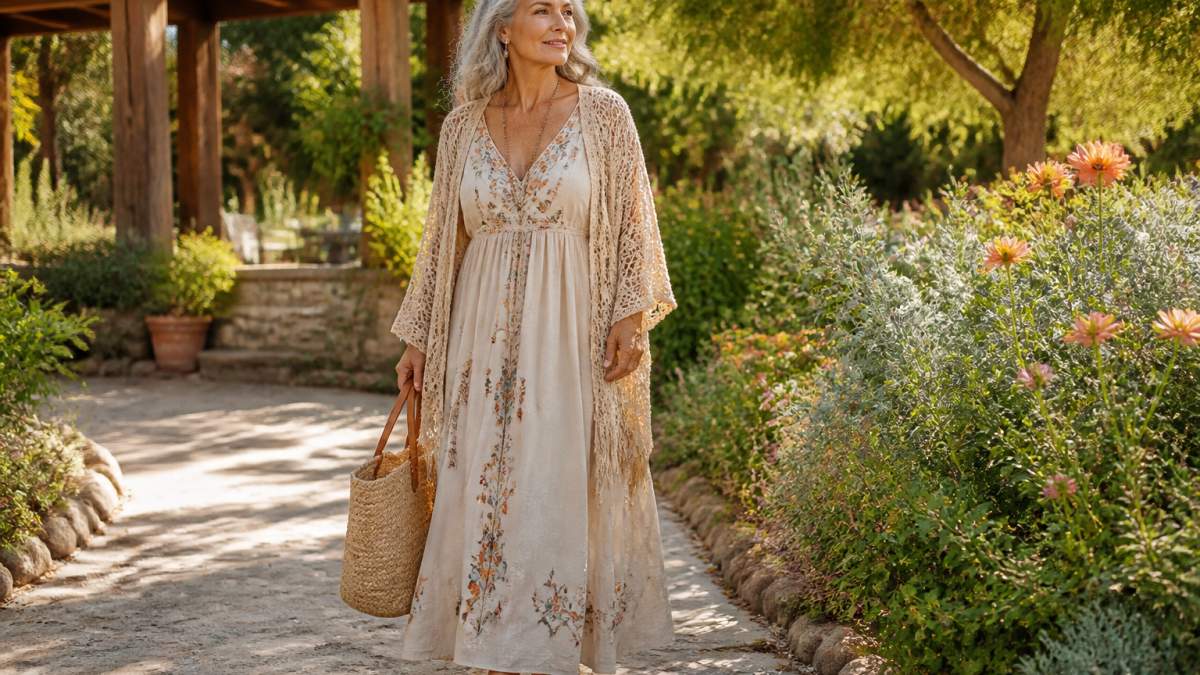
The Four-Part Formula
Every outfit below follows the same structure: one flowing piece, one structured piece, one textural layer, and one accessory focal point. When a look feels off, identify which is missing or doubled up. Two flowing pieces with no structure is the most common failure.
Everyday Wear
Warm weather: Straight-leg linen trousers, a fitted cotton tank, an open long kimono, flat leather sandals, and a woven crossbody. The trousers supply structure, the kimono movement, the tank a clean line.
Cool weather: The same trousers over a thin merino tee, a crochet or knit cardigan instead of the kimono, ankle boots, and a leather shoulder bag.
Casual Days and Errands
Warm weather: A jersey midi dress, a denim or canvas jacket, sneakers or flat sandals, and a canvas tote.
Cool weather: The same dress with a long cardigan, opaque tights, ankle boots, and a scarf at the neck for texture.
Body-shape adjustment: A wrap or empire-waist midi skims the midsection; a straight-cut jersey dress can cling, so choose one with weight and drape.
Work and Smart Casual
Warm weather: Wide-leg linen trousers, an embroidered blouse tucked at the front only, block-heel sandals, and simple stud earrings.
Cool weather: The same trousers with a fine-gauge knit, a longline blazer or duster, closed-toe block heels, and a structured leather bag.
Body-shape adjustment: If tall, a longer duster balances wide-leg trousers; if petite, keep the duster hip-length and the trouser hem off the floor.
Events and Occasions
Warm weather: An embroidered maxi dress with a defined waist, metallic or leather sandals with a low block heel, statement earrings, and a small structured clutch.
Cool weather: A wrap midi dress, a long coat or duster, ankle boots, and a statement necklace.
Body-shape adjustment: A wrap dress adjusts at the waist as weight shifts; a tiered maxi moves away from the hip and thigh.
Travel
Warm weather: A jersey maxi dress, a crochet cardigan, a large woven tote, and flat sandals you can walk in for an hour.
Cool weather: The same dress with a long cardigan, a packable puffer or quilted jacket, ankle boots, and a crossbody bag.
Body-shape adjustment: Choose a maxi with a defined waist or tiered seam rather than a straight tube, and check that the hem clears the ground by an inch or two.
The Throughline
Across all four occasions: one statement piece, everything else supporting it. That is what separates an outfit from a pile of nice clothes. Build each formula in the same tonal family (cream, olive, terracotta, rust, ochre) and the pieces mix across occasions.
Boho Accessories for Women Over 50: Shoes, Bags and Jewelry
Boho accessories for women over 50 should scale to the body, not fight it.
For shoes, flat leather sandals, block heels, and ankle boots cover nearly every outfit, skip anything you cannot walk in for an hour.
Jewelry is where personal style gets loudest. Layered necklaces, hammered metal, wood, and semi-precious stones all fit the aesthetic.
Building a Boho Capsule Wardrobe and Caring for It
A capsule wardrobe is the most practical route into this style, and it answers the cost question: fewer, better pieces worn constantly beat a closet of impulse buys worn twice. Here is a capsule structure, the cost-per-wear math, and the fabric trade-offs and care routines that determine whether the wardrobe lasts.
The Capsule Structure
Start with roughly twelve to fifteen pieces: two dresses, three tops, two skirts, two pairs of trousers, two layering pieces, and three pairs of shoes. Every piece should work with at least three others.
A common pattern is to build the capsule in one tonal family first (cream, olive, terracotta, rust, ochre) and add a second family only after the first is working.
Cost Per Wear: The Math That Matters
Cost per wear is the price of a piece divided by the number of times you wear it.
Before buying, estimate how many times you will realistically wear a piece in the first year. If the answer is fewer than ten, the cost per wear is unlikely to justify the purchase unless it is an occasion piece you will rewear.
Fabric Trade-Offs
Natural fabrics are not interchangeable. Each has a trade-off worth knowing before you buy.
- Linen: Breathes best and softens with washing, but wrinkles readily and has little stretch. Choose a blend for fewer wrinkles, pure linen for maximum breathability.
- Cotton: More wrinkle-resistant than linen and generally less expensive, but heavier cotton can feel stiff and slow to dry. Look for voile or lawn for flowy pieces and poplin for structure.
- Merino wool: Temperature-regulating and odor-resistant, which suits midlife temperature swings, but requires gentler washing and can pill. Fine-gauge merino layers well under kimonos and dusters.
Care Basics That Extend Life
Care for natural fabrics properly and the wardrobe holds for years.
- Washing: Wash linen and cotton cool on a gentle cycle and skip the dryer when you can; hang to dry in shape. Linen softens with every wash.
- Wrinkles: Linen wrinkles by design; if that bothers you, choose a blend or a darker color that hides creases. Steam rather than iron to avoid shine on embroidered pieces.
- Knitwear: Store knits folded rather than hung so shoulders do not stretch. Wash merino by hand or on a wool cycle and dry flat.
For current pieces and sizing, browse our collection directly, since availability changes with each seasonal drop.
Frequently Asked Questions
Can older women wear boho dresses without looking like they're trying too hard?
Yes. The key is choosing cuts that skim rather than swallow the body. A maxi dress with a defined waist, a wrap front or a midi length in linen or cotton reads intentional rather than costume-like. Keep prints to one focal piece, pair with simple leather sandals and skip stacked accessories. Women over 50 wear boho dresses well when the fabric has weight and the silhouette has structure.
Is boho style out of style in 2026?
No. Boho style has shifted rather than faded. The 2026 version leans toward natural fabrics, earthy colors and fewer, better pieces instead of heavy fringe and loud patterns. Linen clothing, crochet cardigans and embroidered blouses remain wardrobe staples, and the look now favors versatile pieces you can mix and match across seasons rather than trend-driven novelty.
What shoes work best with boho outfits for everyday wear?
Leather sandals, woven mules, ankle boots and simple canvas sneakers all work with boho outfits. Match the visual weight of the shoe to the hem: a full maxi skirt balances with a slightly chunkier sandal or boot, while a midi dress suits a flat slide. Avoid anything too delicate under a heavy skirt or too bulky under a floaty top, since proportion is what makes the outfit look deliberate.
How do I accessorize a boho outfit without overdoing it?
Pick one statement accessory and let the rest stay quiet. A woven bag, a beaded necklace or a stack of thin bracelets is enough when your clothing already has embroidery, print or texture. For boho accessories for women over 50, scale matters: a slightly larger bag and mid-size earrings balance a flowing silhouette better than tiny pieces that disappear against the fabric.
Do boho styles work for sizes 14-16 and above?
They can work very well when the cut is designed for the body rather than draped over it. Look for wrap skirts with adjustable ties, blouses with a defined shoulder, and dresses with a seam at the waist. Flowy does not have to mean shapeless. Checking the garment measurements against a piece you already own is the most reliable way to avoid the tent effect when shopping online.
What natural fabrics should I look for in boho clothing?
Cotton, linen, and cotton-linen blends are the core boho fabrics because they breathe and soften with washing. Look for a visible weight to the cloth: thin, sheer linen wrinkles hard and wears out fast, while a mid-weight cotton holds its shape. Check the care label before buying, since some embroidered pieces need cold washing and line drying to keep their shape and color.
0 comments